
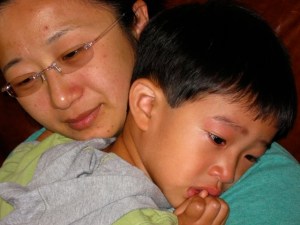
 This past Saturday my 4 year old son wept. He didn’t cry, ball, throw a tantrum, but he simply wept. I always knew that he was a caring, empathetic child but it was the first time I saw his tears as he was experiencing an unpleasant and painful emotion in his life. You see, his grandparents, my parents, had been in town for 6 weeks. Every winter, my parents who are retired, visit us for an extended vacation during the month of December and January. It is their chance for respite from the frigid Midwest and to spend quality time with their grandchildren. As my son grows up, he is beginning to understand just how much they mean to him and he means to them. More than the things they buy him, which is constantly, he cherishes every moment spent with his grandparents, his hanmi and happi. They are always up in his room playing games, roaring like dinosaurs, dancing to his favorite music, playing instruments, kissing him, hugging him, tickling him and loving him. I could plainly see that they delight in him and he in them. For 6 weeks, he experienced what it might be like if we had lived closer to his grandparents rather than 2500 miles away. And this past Saturday at noon, they left. He was sullen all morning and wanted to go with me to the airport to see them off. As we hugged goodbye, I could see the tears well in his eyes as he told them he loved them and watched them head toward the terminal. On our 20 minute drive home, I held his hand as he stared out the window with tears that flowed down his face. His only words were, “Apa(dad), I really miss Hanmi and Happi.”
As I watched my child weep, it was strange to feel both sadness and joy. I was saddened that my son was experiencing painful feelings, but I also felt glad that he was able to express those deep feelings in a natural way. You see, I grew up in an Asian home, a Korean home. And though I am lucky to have such loving and caring parents, I grew up hearing all of the things a little boy might hear, “don’t cry”, “stand and dust yourself off”, “it will be ok”, “suck it up”, “boys can take it”, etc. Looking back, it didn’t help me get over my hurt or pain. It just made me deny and hide my true feelings. Tears were held back, anger was buried, pain was dismissed. And as I grew up, I hadn’t a clue what I was feeling or even who I was. It was only in my mid to late 20’s that I began the journey to self-discovery and reclaim my emotions. And it was through my seminary years that I began to piece myself together, for I knew that if I had no idea who I was or what I was feeling, how was I as a pastor able to truly listen and have empathy for others. Now, some years later, I understand that the steps taken on this intentional journey not only made me a better pastor, but more importantly a better person.
This past week, I was directed to a commencement speech by JK Rowling at Harvard last June. The title of her speech was “The Fringe Benefits of Failure and the Importance of Imagination”. I thought she would talk of imagination as a creative outlet as was clearly visible in her Potter series, but instead she states,
Imagination is not only the uniquely human capacity to envision that which is not, and therefore the fount of all invention and innovation. In its arguably most transformative and revelatory capacity, it is the power that enables us to empathise with humans whose experiences we have never shared. . . . Unlike any other creature on this planet, humans can learn and understand, without having experienced. They can think themselves into other people’s minds, imagine themselves into other people’s places.
Empathy as defined by Merriam-Webster is “the action of understanding, being aware of, being sensitive to, and vicariously experiencing the feelings, thoughts, and experience of another of either the past or present without having the feelings, thoughts, and experience fully communicated in an objectively explicit manner” Empathy is difficult to teach or to instill. And in the world around us, empathy is in such short supply. As JK Rowling continues,
And many prefer not to exercise their imaginations at all. They choose to remain comfortably within the bounds of their own experience, never troubling to wonder how it would feel to have been born other than they are. They can refuse to hear screams or to peer inside cages; they can close their minds and hearts to any suffering that does not touch them personally; they can refuse to know.
And yet, it is what God calls us to do and be, to “love our neighbors as we love ourselves.”
So as I watch the tears flow from my child’s eyes and as he goes through life in his young years, the utterings heard of my childhood will never come out of my mouth. As I held my child’s hand, I told him it is ok to cry, it is ok to feel sad and I will be there for him in whatever way that he wanted. I told him I know he missed his hanmi and happi and that I missed them too. My hope is that in helping him feel and be in touch with his deep emotions, he can learn to better relate and empathize with others.
As we were heading up the steps to our house, he turned to me and said, “apa(dad), are you as sad as I am?” I simply told him that I was sad also and held him tight, knowing that in reality, I wasn’t quite as sad as he was. I do miss them since I only get to see my parents maybe twice a year at the most and we do have a great time together, but 6 weeks is a long time! I do need my house and space back. I need quality time just with my wife and my kids. Being an introvert, I need my own cave time at home. And like any parents, they have their criticism and advise on myriad of things in my life. I need my life back! So I told a little white lie to my son, but no one can say that I am not in touch with my feelings and needs . . . . . and hope my parents don’t get a hold of his blog!
 A few nights ago as I was walking through our living room towards the kitchen, I happened to catch some FoxNews, you know that “fair and balanced” 24 hour news program. Normally it is not a station that I turn to unless I want to know how the other side still thinks, but my parents are in town. My father, who is an incessant news watcher and a republican to boot, was watching the news headlines and the words “Brighton, Michigan” caught my interest. It seems that Brighton, Michigan, my hometown, has passed a law few months ago that as of January 1st, 2009, it makes it unlawful to be annoying in public. Here are the short blurbs from
  For the past two months, I have been complaining and/or dreaming of my imaginary fire. I may be wrong on this, but I think my facebook friends may be tiring of my many “imaginary fire” updates. You see, I indeed have a fireplace in my home here in San Francisco (yes, that is a picture of my fireplace) and on most nights I indeed can build a fire. The sad thing is that I have been absolutely lazy to check the air quality updates on a daily basis. This winter in San Francisco, it is against the law to burn wood in fireplaces on “spare the air days” from November to February. Typically, we have around 20 of these days interspersed throughout these months. The fines begin in the hundreds to thousands. You can see a short article
 So as I was about to take a few “golf” pencils from the back of the pew to poke my eyes and ears out as I sat through an excruciatingly laborious congregational meeting, I was stunned back to reality by two things. First, as I was about to put my head in my hands and stare down to the floor to find a sign that this will get better, I found a shiny penny on the red, just shampooed carpet below me. And secondly in that same exact moment, the elder who was about to take us through the budget for next year mentioned a name, Louise Mueller. Though I knew what the penny was and what it represents, luck or hope or even a sign of uselessness in today’s economy, I had no idea who Louise Mueller was. It was explained to us that Louise was a former member of this church. Because this church touched her so much over the years and because she continues to have such hope for this faith community, she gave a large portion of her estate in her death to our church. Hope comes from such unexpected places. As our economy struggles, so does our churches and the church that I serve is no exception. I believe it hits smaller churches the hardest. But just when things look bleak and the glimmer of hope begins to distinguish, hope arrives unexpectedly.

 InHo Kim - My Faithful Journey